

.svg)

.svg)
%201.png)




A page can be well-written, technically indexable, and relevant to the right keyword but still struggle in organic search because of where it sits within the website.
That is where click depth matters.
Click depth measures how many clicks it takes to reach a page from a starting point, usually the homepage. A page linked directly from the homepage has a click depth of one. A page that requires navigating through a category and subcategory before reaching it may have a click depth of three.
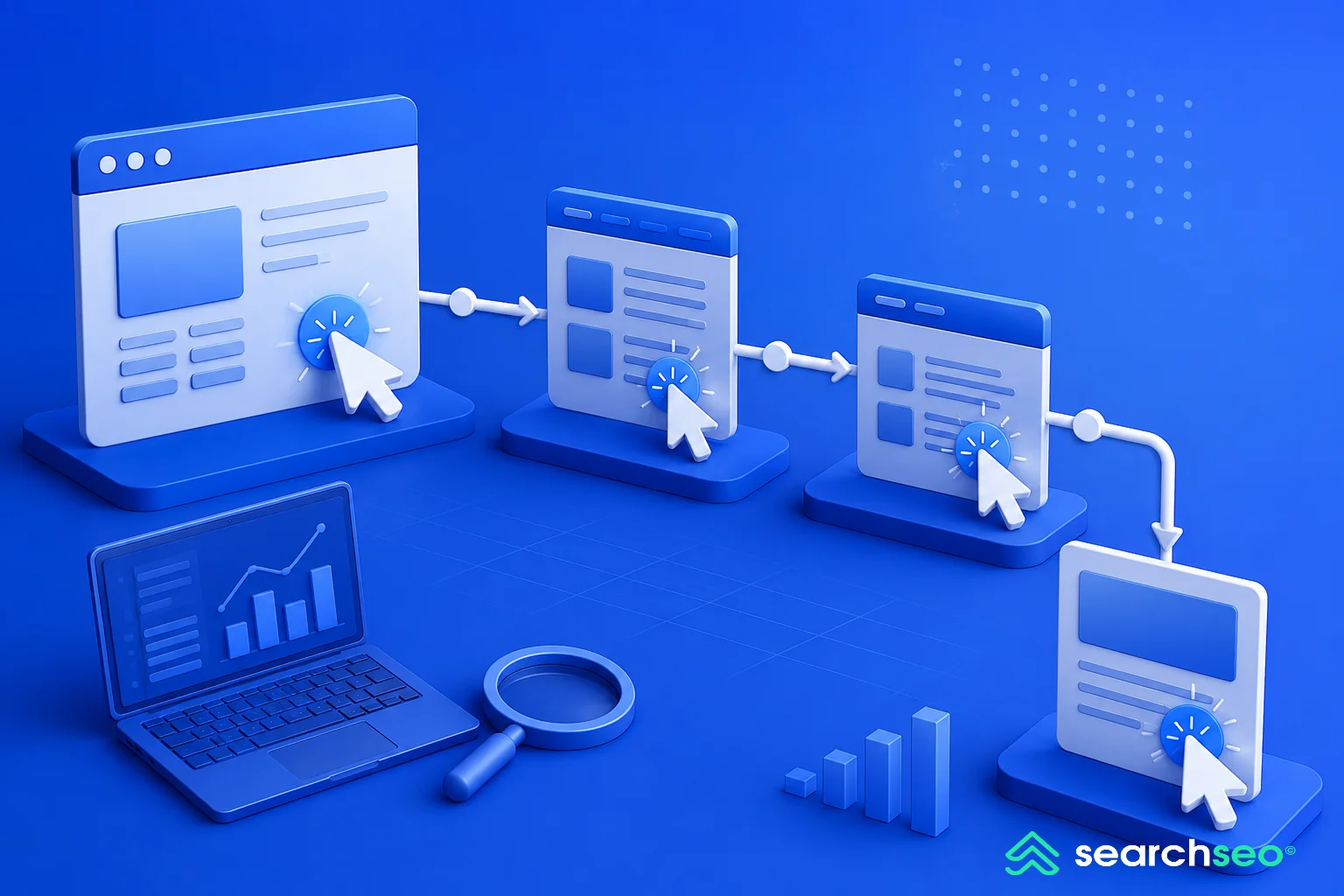
For SEO, this is more than a navigation metric. Click depth affects how easily search engines discover pages, how internal authority moves through a site, and how clearly your site architecture communicates which pages matter most.
For larger websites, it can also expose a common problem: valuable content slowly becoming buried as the site grows.
What is click depth?
Click depth is the number of clicks required to reach a specific page from your website's homepage or another designated starting page.
A simple site might look like this:
Homepage → Category → Article
The article has a click depth of two.
A deeper structure could look like:
Homepage → Resources → SEO → Technical SEO → Guides → Article
The article is five clicks away from the homepage.
Click depth does not measure the URL itself. A URL such as:
example.com/blog/technical-seo/crawling/guide
might look deep because it contains several folders, but it could still have a click depth of one if the homepage links directly to it.
Likewise, a short URL can be buried several clicks into the site.
This distinction matters because search engines discover relationships between pages primarily through links, not simply through how many folders appear in a URL.
Why does click depth matter for SEO?
Click depth matters because internal links create pathways through your website.
Googlebot and other crawlers use these pathways to find content and understand relationships between pages. Users rely on many of the same pathways to move between topics.
As a result, excessively deep pages can create several SEO problems.
1. Deep pages can be harder for search engines to discover
Search engines don't treat every page on a website equally.
When an important page is linked prominently from major sections of the site, crawlers have multiple opportunities to discover and revisit it. When that same page can only be reached after navigating through several layers, discovery may become less efficient.
This is particularly relevant for large websites with thousands of URLs.
Imagine an ecommerce site with this structure:
Homepage → Products → Electronics → Computers → Accessories → Storage → External SSDs → Product
Individual product pages may end up six or seven clicks from the homepage.
Now compare that with a structure that uses useful category pages, contextual links, breadcrumbs, and related-product modules. The same product may become accessible through several shorter paths.
The goal is not necessarily to make every URL one click from the homepage. It is to make important URLs reasonably easy for crawlers to reach.
2. Click depth influences internal link equity
Internal links help distribute authority throughout a website.
Your homepage will often attract a substantial share of external links and internal references. From there, internal links help pass signals toward categories, service pages, articles, product pages, and other sections.
Consider this structure:
Homepage → SEO Services → Technical SEO Services
Compare it with:
Homepage → Resources → Services → SEO → Technical SEO → Technical SEO Services
All else being equal, the first structure establishes a much more direct relationship between the homepage and the commercial page.
That doesn't mean a page at depth four cannot rank. Plenty do.
The more useful question is whether your most commercially or strategically important pages are unnecessarily buried.
If a page is central to your SEO strategy, your internal linking structure should usually reflect that importance.
Click depth is not the same as crawl depth
Click depth and crawl depth are closely related, but they describe slightly different ideas.
Click depth usually describes how many link interactions separate a page from a starting page.
Crawl depth describes how deep a crawler must travel through the site's link structure to discover a URL.
In practical SEO work, the two often overlap. If an important page requires many internal link hops to reach, crawlers may also encounter it relatively late during a crawl.
The distinction becomes more important on complicated websites where crawlers and users can reach pages through different routes.
XML sitemaps, for example, can expose a URL to search engines even when the page is deeply buried within the site's normal navigation.
But an XML sitemap should not be used to compensate for poor internal linking.
If a URL is strategically important, it should normally have meaningful internal links pointing toward it.
What is a good click depth?
There is no universal number that every website needs to follow.
You will often see SEO advice suggesting that important pages should be reachable within three clicks of the homepage. That is a useful rule of thumb, but it should not become an arbitrary technical requirement.
A 50-page SaaS website and a marketplace containing two million URLs cannot realistically use identical architectures.
A better principle is:
The more important a page is to users and organic search, the easier it should generally be to reach through your internal link structure.
For a smaller website, keeping most important pages within two or three clicks may be completely realistic.
For a large ecommerce, publishing, directory, or marketplace site, deeper URLs may be unavoidable. In those cases, the focus should shift toward reducing unnecessary depth and creating additional internal pathways to valuable pages.
How click depth affects internal linking
Click depth problems are often internal linking problems in disguise.
Suppose you publish an article targeting an important keyword.
When first published, it appears on the main blog page and receives links from several recent posts. Its effective depth is relatively low.
Six months later, dozens of newer articles have pushed it deep into pagination.
Its primary discovery path might now look something like:
Homepage → Blog → Page 8 → Article
Nothing about the article itself changed.
But its position within the website did.
This is one reason older content can gradually become structurally isolated even when it remains useful.
Adding contextual internal links from newer or authoritative pages can create much shorter paths:
Technical SEO Guide → Older Article
This is why an effective internal linking strategy should consider more than anchor text. The location and accessibility of the destination page matter too.
Click depth and orphan pages
At the extreme end of the problem are orphan pages.
An orphan page has no crawlable internal links pointing to it.
Technically, its click depth through the normal internal linking structure is effectively undefined because there is no internal path to reach it.
The URL may still exist in an XML sitemap, receive backlinks, appear in analytics, or even remain indexed. But the site architecture is giving search engines very little context about how that page relates to everything else.
This often happens when:
- old blog posts disappear from category archives
- landing pages are removed from navigation but remain live
- products are removed from category pages
- site migrations break internal links
- campaign pages remain accessible after promotions end
- CMS changes create URLs without linking them into the site
Finding these pages can uncover surprisingly valuable SEO opportunities.
If an orphan page still serves a useful search intent, reconnecting it to relevant content and sections of the site can be more effective than simply updating the copy.
How click depth affects user experience
Click depth isn't purely about Googlebot.
Imagine a visitor reading an introductory guide to technical SEO. They want to understand crawling next, but there is no contextual link to a crawling guide. They return to the main navigation, open the blog, find a category, browse several pages, and eventually locate the article.
Technically, the content exists.
Practically, the site made the user work to find it.
Good internal architecture anticipates where users are likely to go next.
A technical SEO hub, for example, might connect directly to pages covering:
- website crawling
- indexing
- robots.txt
- XML sitemaps
- canonical tags
- site architecture
- internal linking
Those links improve discoverability for search engines while also creating a more natural learning path for readers.
This overlap between SEO and usability is important. The best solution to click-depth problems is rarely "add more links everywhere." It is usually create clearer pathways between genuinely related pages.
Click depth and topical authority
Click depth becomes particularly useful when building topic clusters.
Suppose a site wants to establish authority around technical SEO.
Instead of publishing disconnected articles, it creates a central technical SEO hub that links to supporting resources:
Technical SEO Hub
↳ Website Crawling
↳ Indexing
↳ XML Sitemaps
↳ Robots.txt
↳ Canonicalization
↳ Site Architecture
↳ Internal Linking
Supporting articles can then link back to the hub and to closely related pages where appropriate.
This creates a much clearer topical structure.
Search engines don't need to infer the relationship between pages solely from their content. The internal links reinforce it.
This is also why topical authority is not simply about publishing more articles. How those articles connect matters.
You can have 100 pages covering a topic and still build a weak topical structure if the pages are poorly organized and barely linked together.
When deeper click depth is completely normal
Not every deep page needs fixing.
Large ecommerce stores naturally require hierarchy. So do publishers, directories, marketplaces, documentation websites, and international sites.
Trying to flatten everything can actually make navigation worse.
Imagine putting links to 20,000 products directly on an ecommerce homepage just to reduce click depth. The resulting architecture would be useless.
Hierarchy provides context.
The real objective is to find the right balance between structure and accessibility.
Deep pages are less concerning when:
- they target highly specific or low-priority queries
- they are logically grouped beneath useful categories
- breadcrumbs provide additional navigation
- contextual internal links create alternative paths
- crawlers can consistently discover them
- they are not strategically important landing pages
Depth becomes more concerning when high-value URLs are buried without a clear reason.
How to find click-depth problems
A site crawler such as Screaming Frog, Sitebulb, or similar technical SEO tools can calculate crawl depth across a website.
Start the crawl from the homepage and review how URLs are distributed by depth.
You might find something like:
Click depthPagesWhat to review01Homepage125Primary navigation and major landing pages2180Categories and important supporting pages3620Articles, products, and deeper resources4+1,400Review important URLs for excessive depth
The number of pages at each level isn't inherently good or bad.
The valuable part is comparing depth against page importance.
For example, export your click-depth data and combine it with Google Search Console metrics.
You may discover a page that:
- sits at depth five
- receives significant impressions
- ranks between positions 8 and 15
- has few internal links
- targets a commercially valuable query
That is a far more interesting SEO opportunity than a depth-five page with zero impressions and no meaningful business purpose.
How to reduce click depth
Reducing click depth does not require redesigning the entire website.
Often, a few targeted architecture changes are enough.
Add contextual internal links
This is usually the most natural solution.
If an older article is relevant to a newer high-authority page, add a contextual link.
Instead of:
Homepage → Blog → Page 7 → Article
Google may now have another route:
Major Guide → Article
Contextual links are particularly valuable because the surrounding copy helps explain why the pages are related.
Create topic hubs
When you have many pages around the same subject, create a central resource page connecting them.
A strong hub can reduce effective click depth while improving topical organization.
This approach works particularly well for blogs that have accumulated hundreds of disconnected articles over several years.
Improve category pages
Category pages shouldn't exist solely because your CMS automatically created them.
Useful category pages can act as important structural nodes connecting broader topics to more specific content.
If hundreds of articles are buried behind pagination, improving category architecture may dramatically shorten crawler pathways.
Use breadcrumbs
Breadcrumbs provide additional internal links while communicating hierarchy.
For example:
Home → SEO → Technical SEO → Crawling
Each level becomes directly accessible.
Breadcrumbs won't solve every architecture issue, but they are particularly useful on sites with several hierarchical layers.
Link important pages from navigation
Pages central to the business should usually be easy to find.
Core services, product categories, major resources, pricing pages, and other high-priority destinations may deserve placement in primary or secondary navigation.
The key is prioritization.
Adding every page to navigation defeats the purpose.
Update older content
Content refreshes provide a useful opportunity to reassess internal links.
When updating an older article, ask:
What relevant content has been published since this page was created?
Then add links where they genuinely help the reader.
Do the reverse as well. Newer authoritative content may be able to link back to the refreshed page.
This helps prevent valuable evergreen content from becoming progressively buried as your site expands.
Don't optimize click depth in isolation
Click depth is useful, but it should not become another technical metric optimized without context.
Moving a page from depth four to depth two does not automatically improve rankings.
Search performance still depends on factors such as:
- search intent
- content quality and relevance
- competition
- backlinks
- internal anchor text
- technical accessibility
- page experience
- SERP click behavior
A page may be deep because it is unimportant, rather than unimportant because it is deep.
That distinction matters.
Instead of asking:
"Which pages have a click depth greater than three?"
Ask:
"Which important pages are deeper than they should be?"
That produces a much more useful SEO audit.
A practical click-depth audit framework
For larger sites, prioritize URLs using both structural and performance data.
Start with your crawler data and identify pages at higher click depths. Then combine that information with Search Console, analytics, backlink, and keyword data.
Pay particular attention to URLs that have:
High impressions + deeper click depth
These pages already have search visibility. Better internal accessibility may help strengthen them.
Page-two rankings + weak internal linking
Pages ranking around positions 11 to 20 can be good candidates for stronger contextual internal links, especially when the content already satisfies intent.
Commercial value + excessive depth
Service, product, comparison, or conversion-oriented pages shouldn't be structurally buried without a good reason.
Backlinks + poor internal connectivity
If external websites are linking to a page, make sure some of that authority can move naturally into other relevant sections of your site.
Evergreen content + increasing depth
Older content can lose internal prominence as new pages are published. Periodically reconnect strong evergreen pages to your current architecture.
This turns click depth from a crawler statistic into something much more useful: a prioritization signal for internal SEO work.
Click depth matters because architecture communicates priority
Google doesn't see your website as a collection of isolated documents.
It encounters a network of pages connected through links.
Where a page sits in that network helps communicate its relationship to other content and, indirectly, how prominently your website treats it.
That is why click depth deserves attention.
You don't need every URL two clicks from the homepage. You need an architecture where your most important pages are easy to discover, logically connected, and supported by relevant internal links.
As your site grows, periodically review which pages are becoming buried. Some will deserve to remain deep. Others may represent valuable content that your current architecture is quietly underserving.
Fixing those pathways can improve crawling, strengthen internal link distribution, and make the entire site easier for both search engines and users to understand.


.svg)