


SEO and social media marketing are often placed in the same bucket: both bring people to a business without relying entirely on paid ads. In practice, they solve different problems. Search captures demand that already exists. Social media creates attention, earns familiarity, and can shape demand before people start searching.
That difference matters when you are deciding where to put limited time and budget. A social post can introduce a new offer to thousands of people within hours. A well-optimized search page may take months to gain traction, but it can keep attracting qualified visitors long after the original work is done. Neither channel is automatically better. The better long-term growth channel depends on your buying cycle, market, content resources, and the type of asset you are trying to build.
For most businesses, SEO is the stronger foundation for predictable, compounding acquisition. Social media is usually the better channel for distribution, trust-building, feedback, and momentum. The most durable strategy connects the two instead of expecting either one to carry the full growth plan.
SEO vs. social media marketing: the core difference
SEO is the practice of improving a website’s visibility in search engines for relevant queries. The visitor usually arrives with a question, problem, or purchase intention already in mind. A person searching “best accounting software for freelancers” is actively evaluating options. A person searching “how to reduce cart abandonment” may not be ready to buy, but they have a specific need that useful content can address.
Social media marketing works differently. It puts content in front of people while they are scrolling, interacting, or following a topic. The user may not be looking for your solution at that moment. Your job is to earn enough attention that they stop, engage, remember the brand, or take a next step.
Why SEO tends to win for long-term growth
SEO has a slower start because a page needs to be crawled, indexed, understood, and judged against competing results. It also requires useful content, a technically accessible site, internal links, and evidence that the page deserves visibility. This delay can make SEO feel less rewarding than social media in the first few weeks.
Its value becomes clearer over time. An article that ranks for a high-intent topic can keep earning clicks without needing to be republished every day. Product, service, comparison, and problem-solving pages can become durable entry points for visitors who are already close to a decision. Each useful page also strengthens the site’s topical coverage and creates more internal-linking opportunities.
That is why SEO is often described as compounding. One page does not guarantee growth, but a structured library of pages can. A software company might publish a guide for a broad educational query, comparison pages for buyers evaluating alternatives, and solution pages for specific use cases. Over time, those pages support one another and reduce the business’s dependence on a single campaign or platform update.
SEO is especially valuable when your audience uses Google to research before buying. This includes B2B software, local services, professional services, ecommerce categories, finance, health, travel, and many high-consideration purchases. In these markets, the search result is not just a traffic source. It is often the place where the buyer narrows their shortlist.
SEO traffic can be more commercially focused
Search intent gives SEO an important advantage. Someone who searches “emergency plumber near me” has a very different level of urgency from someone who casually watches a home-improvement video. Someone who searches “CRM for small real estate teams” is much closer to evaluating a product than someone who likes a general business tip on social media.
Not every search is transactional, of course. Informational pages can bring broad audiences, and some visitors will leave after finding an answer. But SEO allows you to map content to the buyer journey with more control. You can build pages for early research, solution comparison, pricing questions, objections, and local or product-specific needs. That makes it easier to turn content into a measurable acquisition system.
SEO produces owned, reusable assets
Your website is an asset you control. Search engines can change their ranking systems, but the content, conversion paths, email capture, analytics history, and customer education materials remain yours. You can update a page, improve its title, add clearer examples, strengthen internal links, or adapt it to a new product position without starting from zero.
Social platforms are rented distribution. Your audience may follow you, but the platform decides how much of that audience sees each post. A format change, reduced organic reach, or account issue can sharply alter performance. This does not make social media unimportant. It means businesses should avoid building their entire acquisition model on reach they do not control.
Where social media marketing is stronger
Social media’s main advantage is speed. It can test an angle, launch a message, or put a product in front of a relevant community before an SEO page has even begun to rank. It is also better suited to content that benefits from personality, timely commentary, visual demonstration, behind-the-scenes proof, customer stories, and direct conversation.
For a new brand, social can help establish credibility before people recognize the name in search results. A founder who shares informed industry commentary, a retailer that consistently shows products in real use, or a service business that answers real customer questions can build familiarity much faster through regular social publishing than through search alone.
Social is also useful when there is little existing search demand. If you have created a genuinely new category, waiting for people to search for it may leave you invisible. Social content, partnerships, creator collaborations, and email can introduce the problem and the solution first. SEO becomes more valuable later as the market develops the language to search for it.
Social media offers faster learning loops
A search page can take time to collect enough impressions and clicks to reveal whether its positioning works. Social posts can generate reaction almost immediately. Comments, saves, shares, direct messages, and click patterns show which claims resonate and which questions keep coming up.
Use that feedback as research, not just a performance report. If a short LinkedIn post about a common customer mistake gets thoughtful replies, that may be a strong topic for a detailed SEO article. If a product demonstration gets repeated questions about pricing or setup, those questions may deserve a dedicated FAQ or landing-page section.
The long-term growth question: shelf life versus momentum
The cleanest way to compare the channels is to look at shelf life and momentum.
SEO content usually has longer shelf life. A well-maintained guide can draw traffic for years, particularly when the topic is evergreen and the page continues to satisfy search intent. The work is front-loaded: research, writing, optimization, technical review, links, and updates. The payoff tends to arrive later and last longer.
Social content usually has stronger short-term momentum. It can create a spike in attention, prompt discussion, and expand reach quickly. But most individual posts fade rapidly. A strong content system therefore needs regular publishing, repurposing, community management, and creative renewal.
There are exceptions. A social video can remain discoverable for months, especially on search-friendly platforms, and a search page can lose visibility after competitors improve their content. Still, the basic pattern holds: SEO is better at creating durable demand capture; social is better at maintaining visible, active brand presence.
Which channel should you prioritize?
Prioritize SEO first when people already search for the problem you solve, your offer has clear commercial intent, and you can commit to publishing and improving content over several months. It is a strong choice when leads or sales can be tied to specific queries, such as local services, product categories, comparison searches, or industry problems.
Prioritize social media first when your product is highly visual, your buyers spend meaningful time in a defined community, or the brand depends on personal trust and point of view. It is also useful when you need rapid validation, are launching something new, or have a short-term event, trend, or campaign to support.
How to make SEO and social media work together
The strongest approach is not to publish the same idea in two places and call it integrated marketing. Give each channel a job.
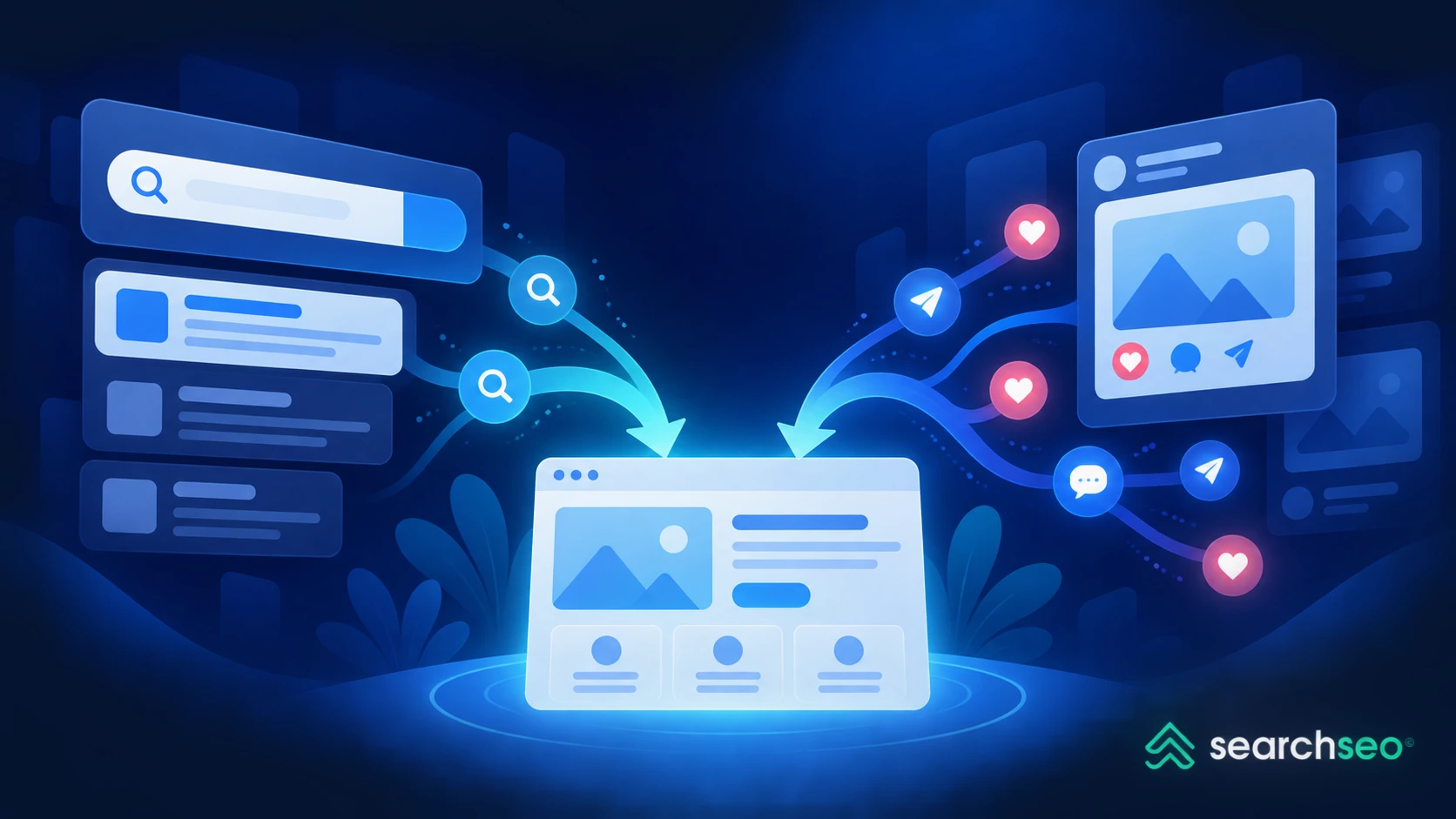
Start with a useful search-focused asset: a guide, comparison page, case study, calculator, product page, or resource that answers a meaningful customer question. Then use social to distribute pieces of that asset in native formats. A single guide can become a short opinion post, a carousel of mistakes to avoid, a customer example, a poll, and a concise video explanation. Each piece should stand on its own while pointing interested readers to the fuller resource.
Then reverse the flow. Watch social conversations for recurring objections, wording, and questions. Add the useful patterns to your SEO content. This makes the website more aligned with how real buyers talk, while social becomes a continuous research channel instead of a separate content treadmill.
A practical 90-day approach
- Choose three commercial SEO topics. Select problems with clear relevance to your offer and realistic search demand. Build or upgrade the pages that should rank for them.
- Create supporting educational content. Answer the questions that appear before a buyer is ready to compare solutions. Link these pages naturally to relevant service or product pages.
- Turn each core page into social angles. Extract specific lessons, examples, myths, data points, or decisions. Do not simply post a link with a generic caption.
- Measure the right outcomes. Track organic impressions, rankings, qualified conversions, and assisted leads for SEO. For social, track meaningful engagement, referral visits, branded searches, and assisted conversions rather than follower count alone.
- Refresh what proves useful. Improve pages that earn impressions but underperform on clicks, and expand social themes that attract qualified conversations.
Common mistakes when comparing SEO and social media
The first mistake is judging SEO too early. A new content program rarely produces its full value in 30 days. Rankings, links, and topical authority take time, particularly in competitive markets. Evaluate SEO on a longer horizon while still using leading indicators such as indexation, impressions, position movement, and query growth.
The second is judging social media only by reach. A viral post can be valuable, but it is not automatically a growth asset. Ask whether it reached the right people, generated qualified visits, strengthened brand recall, or revealed useful customer insight. A smaller post that leads to real conversations may be more valuable than a large, irrelevant audience spike.
The third is sending traffic to weak destinations. Social campaigns and high rankings cannot fix a page that does not explain the offer, answer key objections, or make the next step clear. Improve the landing experience before scaling distribution.
Final verdict
If you must choose one channel for long-term, measurable acquisition, SEO usually delivers the stronger foundation. It captures people with active intent and creates website assets that can keep producing value long after publication.
Social media is not a substitute for that foundation, but it is an important accelerator. It helps a brand stay visible, test messages, build familiarity, and turn useful content into a conversation. The businesses that grow most steadily tend to use SEO to own demand capture and social media to earn attention around it.


