

.svg)

.svg)
%201.png)


You check your rankings. Position 3. Same as last month. But your organic traffic is down 18%. Sound familiar? You are not imagining things, and your site is not broken. What changed is the SERP itself. The page of results users see is no longer a clean list of ten blue links waiting to be clicked. It is a crowded mix of ads, map packs, shopping carousels, featured snippets, and now AI-generated answers. And each of those features takes a share of clicks that would have gone to organic results.
Understanding SERP features impact on organic CTR is one of the most underrated diagnostics in modern SEO. This article breaks down exactly which SERP features are stealing clicks, how much each one costs you, and what you can actually do to protect your organic traffic.
The shrinking organic SERP
In 2016, opening Google on desktop showed you paid ads at the top and then organic results almost immediately. Above-the-fold organic was practically guaranteed for anyone in positions 1 through 3. That era is over.
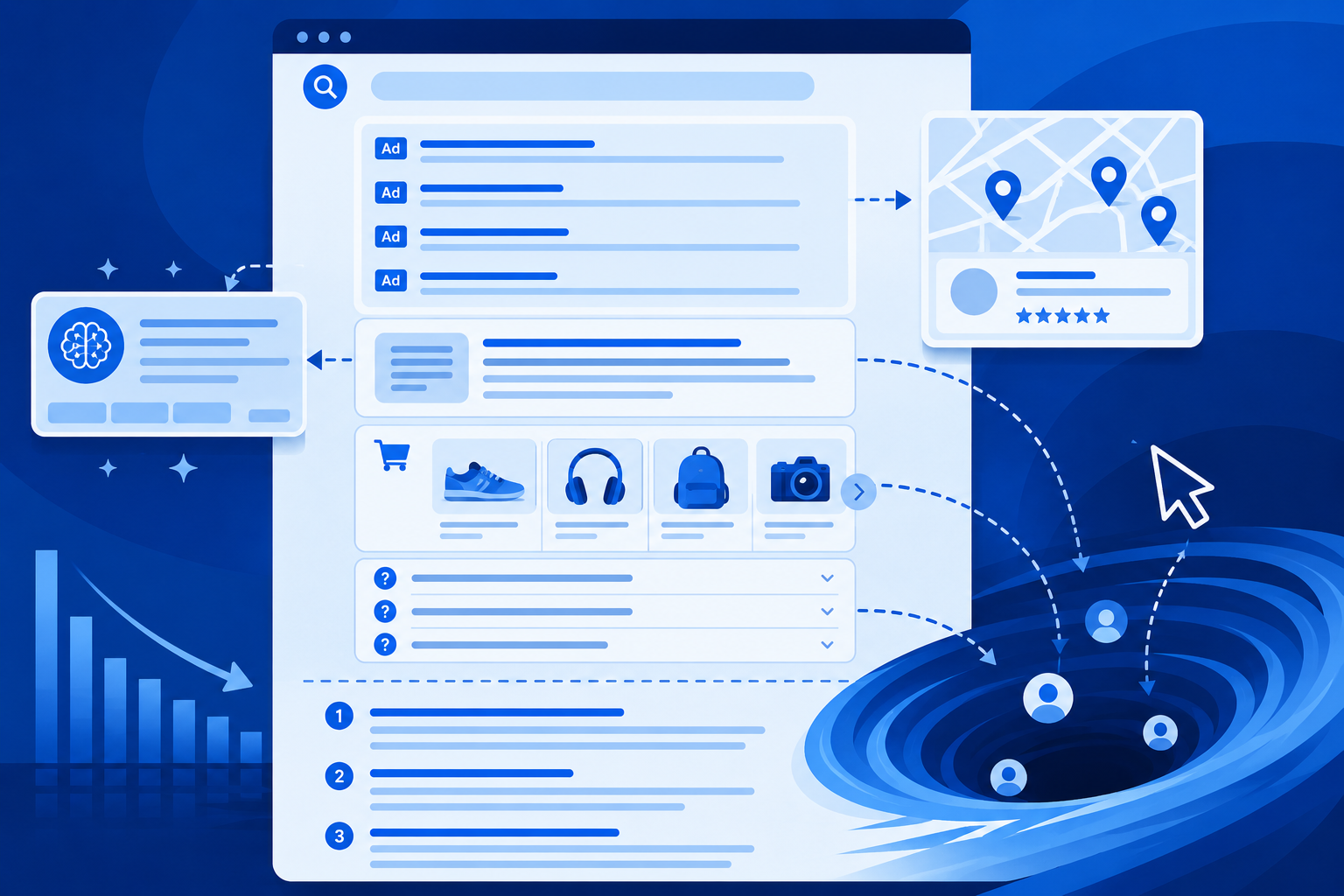
Today, a typical commercial or local query can show four paid ads, a local 3-pack with a map, a featured snippet, and a People Also Ask accordion before a single organic result appears. On mobile, which now accounts for the majority of searches, organic results can be pushed so far down the page that a large share of users never see them at all.
Data point: Research from Advanced Web Ranking consistently shows that position 1 organic CTR drops significantly when SERP features are present above it. A page that might expect 28% CTR in a clean SERP can see that figure fall below 15% when ads, a local pack, and a featured snippet all appear in the same results page.
This is not a ranking problem. It is a SEO visibility problem. Knowing what CTR is and how it is measured is just the starting point. The harder question is why your CTR is falling even when your rankings are not.
PPC ads: the click cannibals above the fold
Google Ads sit at the very top of the page, and on commercial queries, there can be up to four of them. For anyone who learned SEO in the early 2010s, this is nothing new. But the scale and targeting precision of Google Ads has grown dramatically, which means more query types are now dominated by ads than ever before.
The CTR impact depends heavily on query type. Here is roughly how it breaks down:
- Product queries: (e.g., "buy running shoes size 10"): up to four Shopping ads and four text ads can appear, pushing organic to the bottom of the visible screen or below it entirely.
- Local service queries: (e.g., "emergency plumber London"): Local Services Ads (the Google Guaranteed listings) now appear above even standard text ads in many markets, adding another layer above organic.
- Branded queries: competitor bidding means your own branded search can show a rival's ad above your organic result. This is particularly damaging because branded CTR is normally your highest-converting traffic.
The practical impact is that for any query with clear commercial intent, organic position 1 is often effectively position 5 or 6 on the visual page. Users who do not scroll (and most do not on mobile) never reach organic results at all.
Google Maps and the local pack: the local CTR thief
For any query with local intent, whether it includes a location modifier ("plumber in Manchester") or Google infers local intent from context ("best coffee near me"), the 3-pack dominates. These three map listings appear above organic results and take up significant visual space with a map, star ratings, opening hours, and click-to-call buttons.
BrightLocal research: The local 3-pack appears in approximately 93% of searches with local intent. For those searches, the three businesses in the pack receive a combined click share that frequently exceeds the total for all ten organic results below them.
The CTR math here is brutal for organic results. If your site ranks position 1 organically for a local query, but a map pack sits above you, your expected CTR can fall from roughly 28% (clean SERP) to somewhere between 8% and 12%. You did the SEO work. You earned the ranking. But three businesses with an optimised Google Business Profile are collecting most of the clicks.
Even more damaging: the map pack is increasingly accompanied by Local Services Ads above it, meaning organic position 1 for a local query is sometimes the seventh or eighth clickable element on the page.
Google Shopping: visual carousels win on product queries
Shopping carousels are particularly effective click magnets because they combine images, prices, and brand names in a visual format that is fundamentally more compelling than a text link. For product-intent queries, the Shopping carousel appears at the top of the page, sometimes spanning the full width.
The data on Shopping's CTR impact is striking. Studies from Search Engine Land and Merkle have shown that Shopping ads capture between 60% and 85% of clicks on product queries, leaving organic results fighting over the remainder. For an e-commerce site that has invested heavily in SEO, this is a significant structural disadvantage.
The visual nature of Shopping makes it particularly hard to compete with through text-based organic results. A user searching for a laptop bag sees five products with images and prices before reading a single organic title tag. The cognitive shortcut to click the visual result is strong, even for users who would otherwise be drawn to organic content.
For e-commerce SEOs, the implication is that product page organic rankings are yielding diminishing returns on Shopping-dominated SERPs. Category pages and informational content (buying guides, comparison articles) tend to fare better because Shopping ads are less dominant on those query types.
AI Overviews: the newest and fastest-growing click trap
AI Overviews (formerly Search Generative Experience) represent the newest and in some ways most disruptive SERP feature for organic CTR. Unlike ads or the map pack, which redirect users to external sites, AI Overviews answer the question directly in the SERP. Users get what they came for without clicking anything.
Early data from Semrush, SparkToro, and Authoritas following the broad rollout of AI Overviews in 2024 consistently pointed in the same direction: queries that trigger an AI Overview see meaningfully lower organic CTR than equivalent queries without one. Estimates vary, but reductions of 20% to 30% in organic CTR for AI Overview queries have been widely reported.
The query types most affected are predictably the ones that have always been informational content's home turf:
- Definition and "what is" queries
- How-to and step-by-step instructions
- Factual lookups (dates, distances, conversions)
- Simple comparison questions
For content marketers and SEO teams that have invested in informational content as a traffic driver, this is a structural shift. Being cited in an AI Overview does not reliably translate into traffic. The overview answers the question; the citation is largely decorative. For a deeper look at this dynamic, our article on CTR in the AI search era covers the implications in full.
What SEOs can actually do about it
None of this is cause for panic, but it does require a realistic recalibration of how you measure and pursue organic performance. Here is a practical framework:
1. Compete for the features, not just against them
Optimizing for the map pack (Google Business Profile completeness, review volume, local citations) means you become the click thief rather than the victim on local queries. Similarly, structured data and schema markup give your organic results the best chance of appearing in rich results, featured snippets, or even AI Overviews, which at least puts your brand name in front of users even if the click does not follow.
2. Prioritize query types where features are less dominant
Long-tail informational queries, brand-adjacent queries, and niche comparison content are less frequently targeted by Shopping ads and local packs. These SERPs tend to be cleaner and your organic CTR should be closer to benchmark. Building topical depth around these areas is a more defensible content strategy in a feature-heavy SERP environment.
3. Maximize the CTR you do get
Here is the core insight this article has been building toward: you cannot control how many SERP features Google places above you. But you can control how many of the remaining available clicks you capture. This is where CTR optimization becomes critically important. Strong title tags, compelling meta descriptions, schema-enhanced snippets, and structured URL formatting all directly influence whether a user chooses your result over the one below it.
Beyond on-page optimization, CTR manipulation through behavioral signals is a lever that many SEO teams underuse. When Google observes that users consistently choose your result and engage with it, that behavioral signal can reinforce your rankings and compound the CTR advantage over time. In a SERP where features are claiming a growing share of total clicks, maximising your share of what remains is the strategic priority.
4. Track SERP feature presence alongside CTR in GSC
Google Search Console shows you impression and click data by query, but it does not automatically show you which queries are feature-heavy. Pairing your GSC data with a rank tracker that records SERP features lets you identify which ranking positions are being systematically undercut by the local pack, ads, or AI Overviews. This turns a vague "CTR is down" diagnosis into a specific and actionable one.
The organic click is a smaller prize, but still worth competing for
The organic search click has not disappeared. It has become a smaller percentage of a total that is itself growing. Billions of searches happen every day, and organic results still capture a meaningful share. The SEOs who will win in this environment are not the ones who ignore SERP features and keep optimising as if it is 2018. They are the ones who understand exactly which features are suppressing their CTR, on which queries, and by how much, and then build a strategy around making the most of every click that is still available to them.
Ranking matters. But in 2026, the gap between ranking and getting the click has never been wider. Closing that gap is the real SEO challenge.
Want to maximize the organic clicks you are still getting?
SERP features are claiming more of the pie every year. The response is not to abandon organic SEO, but to ensure every available click comes to you. Explore how CTR manipulation with SearchSEO can help you get the most from your existing rankings.


.svg)