

.svg)

.svg)
%201.png)


Buying organic website traffic sounds contradictory.
Organic traffic normally describes visitors who reach your website through unpaid search results. If you are paying for those visits, can they really be called organic?
That distinction matters.
When most providers talk about buying organic website traffic, they are referring to paid traffic campaigns designed to generate visits through search-related journeys rather than through conventional display ads or direct pageviews. Depending on the service, a campaign may target particular keywords, countries, devices, URLs, session lengths, or other behaviors.
That does not make purchased traffic equivalent to the traffic you earn because a page ranks naturally for a competitive query.
The two can serve different purposes.
Traditional SEO builds long-term search visibility through content, technical improvements, internal linking, authority, and better alignment with search intent. Purchased search-driven traffic can be used more selectively to generate visits, test pages, collect engagement data, or support campaigns around URLs that already have a clear SEO strategy.
The key is understanding what you are actually buying.
More visits on an analytics chart are easy to generate. Useful traffic is harder.
This guide explains how buying organic website traffic works, what to look for in a provider, when it can make sense, when it probably will not help, and how SearchSEO fits into a wider SEO strategy.
What does it mean to buy organic website traffic?
Buying organic website traffic generally means paying a provider to generate visits that originate from or simulate a search-driven journey rather than a paid advertisement. It is different from earning organic traffic through SEO, where visitors find your website naturally because your pages rank for their searches.
That difference is worth keeping clear.
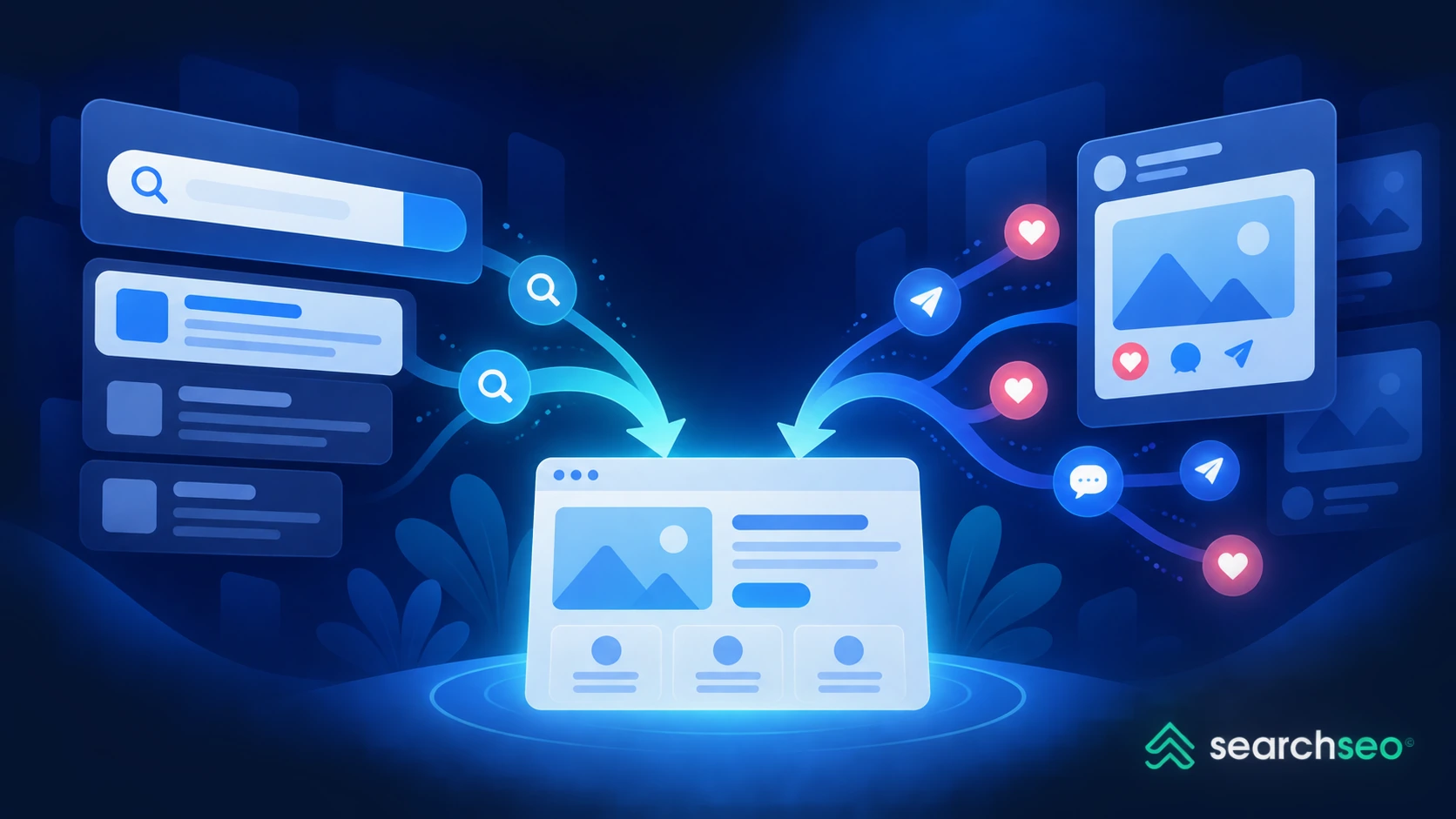
A website can receive traffic from several sources:
The distinction becomes especially important when evaluating traffic services.
A provider saying it can generate "10,000 organic visitors" tells you very little by itself.
You need to know:
- Where do the visits originate?
- Are specific keywords involved?
- Can geography be controlled?
- What devices are used?
- Is the visitor reaching your website through a search result or directly?
- What happens after the landing page loads?
- Can you identify the traffic separately in your analytics?
- Is the campaign useful for the objective you actually care about?
The source and behavior of the traffic matter more than the label attached to the package.
Who can benefit from buying website traffic
- Website & e-commerce owners – Generate a predictable flow of visitors to hit revenue targets. Typical uses: launching new products, reviving plateauing stores, or improving analytics before an investor pitch.
- SEO and digital agencies – Meet aggressive KPIs across multiple client accounts without ballooning ad spend. Often paired with technical fixes and link-building sprints to shorten time-to-rank.
- In-house marketing teams – Bridge the “traffic gap” while long-form content and PR campaigns gather momentum. Ideal for speeding up A/B tests and smoothing seasonal demand swings.
- Freelance growth consultants – Deliver quick, demonstrable wins that open the door to larger CRO or SEO retainers.
- Start-ups and SMEs – Offset limited PPC budgets while gathering the data needed to prove product-market fit and attract funding.
Key benefits of purchasing organic web traffic

- Custom-fit campaign architecture – You control visit cadence, device mix, dwell-time targets, even scroll depth. Every variable maps to your funnel goals.
- Human-grade, high-fidelity traffic – Real browsers on residential proxies mimic authentic user journeys and protect you from bot-pattern penalties.
- Laser-targeted geo and demographic filters – Drive engagement from the exact regions or buyer personas that matter to your revenue forecasts.
- Actionable, transparent analytics – UTM-tagged sessions feed into Google Analytics, Search Console, and BI dashboards, isolating lift and proving ROI.
- Adaptive CTR & behavioral-signal boosts – Modulate click-through rate, dwell time, and return-visit frequency to reinforce on-page relevance signals as algorithms evolve.
- Compliance safeguards – Throttle controls, randomized interaction patterns, and captcha-aware routing keep campaigns inside search-engine guidelines.
- Effortless scalability – Start with a micro-burst for a pilot page, then ramp to enterprise volumes without re-architecting your stack.
Why marketers buy traffic for their website and turn to automation
- Accelerate search rankings
Higher click-through rates and stronger engagement signals can help pages gain momentum in search results faster than relying on organic growth alone. When combined with quality content, solid on-page SEO, and gradual traffic scaling, automated traffic campaigns can support ranking improvements over time. - Stress-test infrastructure
Simulated website traffic surges reveal server bottlenecks before real customers run into errors. Scale traffic in phases and monitor response-time dashboards as you go. - Validate funnel assumptions
Simulated traffic surges help identify server limitations, slow-loading pages, and scalability issues before real users encounter them. By increasing traffic in controlled phases and monitoring performance metrics, businesses can improve site stability and user experience. - Demonstrate traction to stakeholders
Healthy engagement metrics strengthen fundraising decks, partner negotiations, and M&A due-diligence. Keep full audit logs so you can separate pilot traffic from earned traffic later. - Support geo-targeted market expansionDirect signals from target regions improve local rankings and uncover cultural UX insights, so long as landing pages match language, currency, and compliance norms.
Traffic bots vs. high-quality paid traffic
- Raw scripts (risk-heavy): Simple bots hammer pages, inflate vanity metrics, and wave red flags to anti-spam systems.
- Behaviorally engineered visits (opportunity-rich): Real browser instances on residential IPs reproduce human click paths, session depth, and engagement patterns, transforming “automation” into a smart behavioral-signal strategy.
Geo-targeting made simple
Select one country or mix several, all priced in your local currency. Regional signals sync with your hreflang tags and country-coded subfolders for a cohesive international SEO posture.
How can I buy organic web traffic?
- Choose a reputable provider. Look for residential IPs, real-browser sessions, and transparent metrics.
- Define your campaign. Select keywords, geo-location, device mix, and session goals.
- Launch and monitor. Tag visits with UTM parameters so you can isolate performance in Google Analytics.
- Iterate. Adjust velocity and behavior settings based on ranking movement and engagement data.
With SearchSEO.io website traffic, the process is streamlined: sign up for the free 3-day trial, plug in target keywords, pick from 150+ countries, set session length, and watch clicks register inside your analytics dashboard. The platform’s residential network and human-like browsing patterns keep campaigns compliant while amplifying real SEO work.
How do I get more organic traffic to my website?
- Optimize on-page elements. Research intent-aligned keywords, craft compelling titles/meta descriptions, and structure content for readability.
- Publish valuable content consistently. Depth, originality, and freshness keep both users and crawlers engaged.
- Earn authoritative backlinks. Partnerships, digital PR, and thought-leadership pieces build trust signals.
- Ensure technical health. Fast load times, mobile responsiveness, and schema markup improve crawlability and UX.
- Amplify behavioral signals. Higher CTR and longer sessions tell algorithms that users prefer your result. Tools like SearchSEO.io can supply controlled, human-grade traffic bursts that reinforce those signals while you execute long-term SEO work.
What makes SearchSEO.io different from generic traffic bots?
- Largest residential proxy pool for genuine IP diversity.
- Fully customizable sessions (1–5 minutes+, multi-page journeys, return visits).
- Keyword-driven SERP clicks rather than direct URL hits, boosting true organic CTR.
- 150+ geo-locations to support local and international SEO strategies.
- Real-time dashboard that pipes data straight into Google Analytics & Search Console.
Does SearchSEO.io offer a free trial? Yes. Every new account starts with a 3-day, no-credit-card trial, so you can validate metrics before committing to a paid plan.
Can I target specific countries or devices?
Absolutely. Select one or multiple countries, or even a regional mix, and define desktop vs. mobile ratios. Geo-targeting aligns with hreflang tags and local landing pages, giving search algorithms clear relevance signals.
Bottom line
Automation by buying website traffic is neither cheat code nor silver bullet, it’s a precision tool. Configure it carefully and pair it with high-value content, authoritative backlinks, and solid technical SEO. Used this way, premium traffic acquisition becomes an accelerator on your path to sustainable growth.


.svg)