

.svg)

.svg)
%201.png)





Short answer: yes, Bing CTR manipulation works better and faster than the Google version, but "works" doesn't mean "worth it" for every site. And in 2026, there's a second reason to care about it beyond blue-link rankings: Bing's index is the backbone for a large share of AI answer engines, so what you do here can also shape whether your site gets cited in AI responses.
Why Bing rankings matter more than they used to
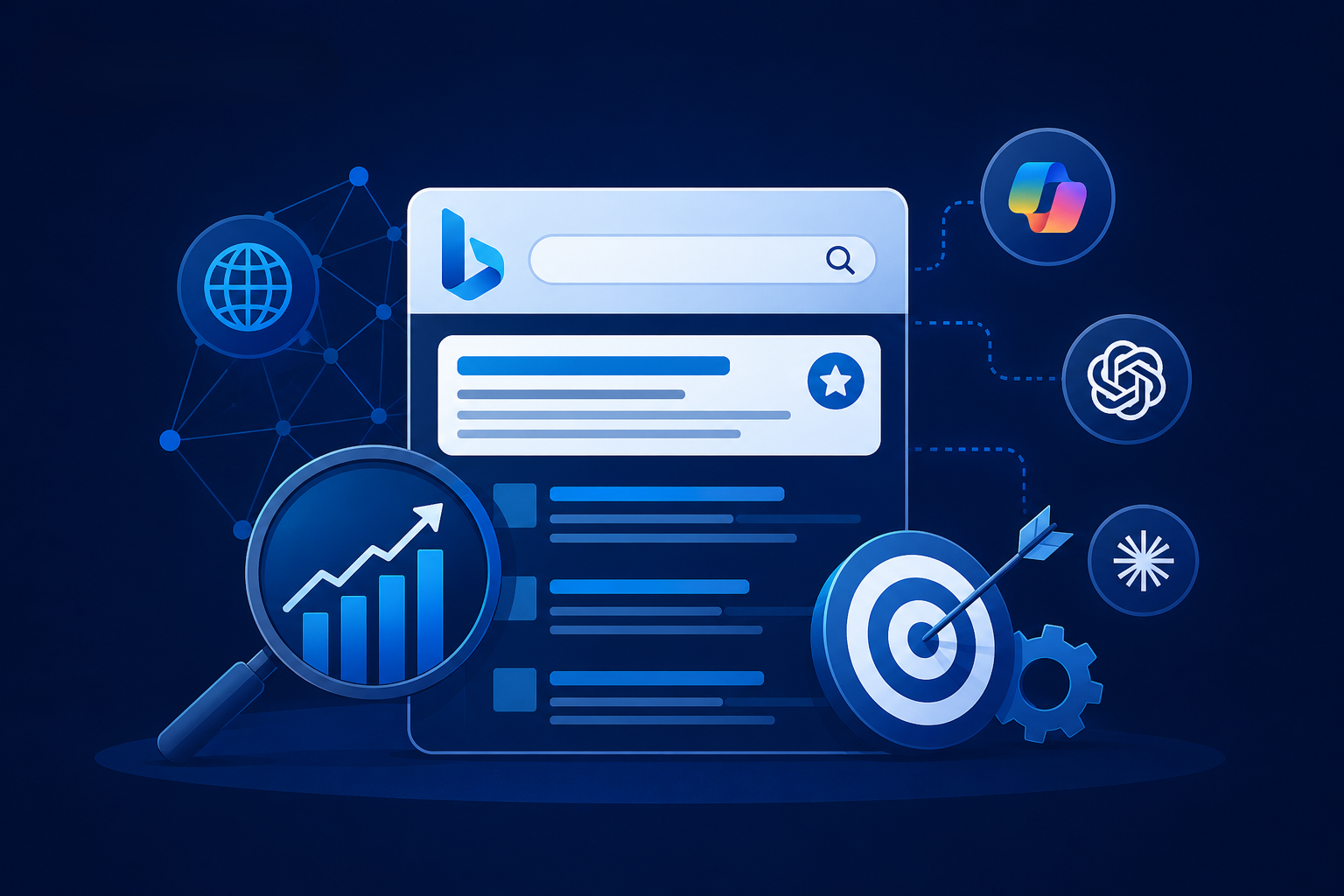
Bing isn't just Bing anymore. Copilot runs on Bing's index and ranking signals. ChatGPT's search and browsing features route through Bing's API for a large share of queries. Perplexity and several other AI answer engines lean on Bing data as well. That means improving where you sit in Bing's index doesn't just move your position in a traditional SERP, it also changes your odds of being pulled into an AI-generated answer as a cited source.
This is the part a lot of SEOs miss. They treat Bing as a smaller, lower-priority version of Google. But if your goal now includes showing up as a citation in Copilot or ChatGPT, Bing is arguably the more important index to optimize for, not the secondary one.
How Bing uses CTR and engagement signals
Bing weighs click and engagement data more heavily than Google typically admits to. Its ranking systems pull from Bing Webmaster Tools data, click-through and impression data from Bing search, and behavioral signals like dwell time and bounce rate. Bing also indexes far fewer pages than Google, so the signal-to-noise ratio per query is lower, meaning a burst of clicks on your listing has more relative weight against a smaller pool of competing results.
Combine that with IndexNow, which Bing uses to get pages crawled and re-evaluated fast, and you get a feedback loop that responds to CTR changes on a shorter timeline than Google does. Where a Google CTR campaign might take four to eight weeks to show movement, Bing listings can shift in one to two weeks. That faster cycle also means a faster path to becoming eligible for AI citation, since answer engines are generally pulling from a page's current standing, not a stale snapshot.
Why Bing is considered an easier environment for this
Three practical reasons SEOs gravitate to Bing for CTR work:
- Smaller competitive index. Fewer pages competing for a given query means less noise to overcome to register a signal.
- Less mature bot detection. Bing Webmaster Tools flags obvious patterns, but its detection stack isn't running the same volume of adversarial ML that Google's spam systems do. Poorly executed campaigns still get caught, but the bar for "well executed" is lower.
- Lower cost to test. Bing's ad and traffic ecosystem is cheaper across the board, so testing a CTR campaign on a Bing ranking costs less to run and less to lose if it doesn't pan out.
None of this means Bing is unmonitored. It means the margin for error is wider, not that there is no margin.
What "working" actually looks like, for rankings and for AI citations
CTR manipulation on Bing typically produces:
- Ranking movement of a few positions within a SERP cluster (moving from position 8 to position 3, for example), not jumps from page 3 to page 1 out of nothing
- Faster re-crawl and re-evaluation of the page due to IndexNow
- Improved click share on existing impressions, which compounds the effect if the underlying page also converts
- Better odds of being sampled as a source when an AI answer engine pulls from Bing's top results for a query your page ranks for
It does not fix a page with no backlinks, thin content, or a domain with no trust signals, and it doesn't manufacture AI citations on its own either. AI answer engines are still selecting from pages that already rank well and read as authoritative. CTR manipulation nudges a ranking that already has a plausible reason to be near where you're pushing it. It is not a substitute for the on-page and off-page fundamentals that make a page citation-worthy in the first place.
Risks and downsides
The failure modes are consistent across the campaigns that get flagged:
- Traffic pattern uniformity. Identical dwell times, identical click paths, identical device or OS fingerprints across sessions is the single biggest tell.
- Geographic and referrer mismatch. Traffic that doesn't match your actual audience geography or arrives with no plausible referrer chain stands out against a smaller Bing traffic baseline.
- Volume outpacing organic plausibility. A page that normally gets 20 impressions a day suddenly getting 400 clicks looks exactly like what it is.
Bing Webmaster Tools can and does suppress or penalize listings tied to detected manipulation, and recovery isn't instant. A penalized listing doesn't just lose ranking position, it also drops out of consideration for AI citation, since answer engines aren't going to surface a page Bing itself has flagged. The downside isn't hypothetical, it's a known outcome for sloppy execution.
Is it worth it
For a site that already has reasonable content and some link equity and is sitting just outside the top 3 for a commercially valuable term, yes, and the AI citation upside makes the case stronger than it used to be. The cost of testing is low relative to Google, the timeline to see results is short, and Bing's traffic, while smaller in volume, tends to convert at a comparable or higher rate for certain verticals. That conversion pattern makes Bing B2B traffic particularly relevant for professional services and enterprise offers. On top of that, a page that climbs into Bing's top results has a real shot at being quoted by Copilot or surfaced by ChatGPT for the same query, which is traffic and brand exposure you don't get from a traditional ranking alone.
For a site trying to force a ranking it hasn't earned, or for a query with negligible Bing search volume to begin with, it's not worth the setup time. Check your query's actual Bing volume before committing resources.
If you're weighing whether to build and run this yourself or have it handled, our CTR Manipulation Service manages the execution end to end, including the traffic sourcing and pattern variation that keeps campaigns under the radar.
Doing it properly if you proceed
If you decide to run it, the mechanics that separate a working campaign from a flagged one:
- Vary click paths, dwell time, and device fingerprints across sessions rather than running a single template
- Match traffic geography to your actual target market
- Scale gradually against your existing impression baseline instead of spiking volume overnight
- Pair the CTR push with genuine on-page relevance and clear, quotable answers so the ranking holds once the campaign ends, and so the page reads as citation-worthy to an AI system sampling it
This is also where the human vs. bot traffic question matters most. Our breakdown on CTR bots vs. human traffic: what actually moves rankings goes into which traffic sources actually register as legitimate signal versus which get filtered before they ever touch your ranking.
If you need the actual traffic sourced rather than just the CTR pattern managed, our Bing Traffic Service covers that piece directly.


.svg)